
Most businesses think they have a traffic problem. In reality, they have a conversion problem.
You can run ads, do SEO, post content, and still see zero meaningful results if your website isn’t built to convert. Getting visitors is only step one. Turning them into leads or customers is where most brands fail.
Let’s get straight to the point. A good-looking website does not equal a high-performing website.
The first issue is lack of clarity. When someone lands on your website, they should immediately understand what you do, who it’s for, and why it matters. If your homepage is vague or overloaded with generic messaging, users leave. You don’t get a second chance.
Most websites try to say everything instead of saying one thing clearly.
The second problem is weak value positioning. If your offer looks the same as everyone else in the market, there’s no reason for a visitor to choose you. Your website should clearly communicate your edge. Not features. Not services. Actual outcomes.
For example, instead of saying “we offer digital marketing,” you should be communicating measurable results like lead generation, cost reduction, or revenue growth.
Third — poor structure.
Users don’t read websites. They scan. If your content is not structured properly with clear sections, headings, and flow, they won’t engage. A high-converting website guides users step by step. From awareness to interest to action.
Here’s what that flow should look like:
Clear headline → Problem → Solution → Proof → Offer → CTA
If your website skips this structure, you lose conversions.
Another major issue is weak or missing CTAs.
Many websites either hide their call-to-action or make it too passive. “Learn more” doesn’t drive action. “Book a strategy call” does. Your CTA should be clear, visible, and repeated across the page. You shouldn’t make users search for the next step.
Then comes trust.
People don’t convert unless they trust you. And trust isn’t built with claims. It’s built with proof. Testimonials, case studies, client results, and data points all play a role. If your website lacks credibility elements, users hesitate.
And hesitation kills conversions.
Speed and mobile experience are also non-negotiable. A slow website or broken mobile layout instantly drops your conversion rate. Most users are browsing on their phones. If your site isn’t optimized, you’re losing opportunities before the conversation even starts.
Now let’s talk about forms.
Many businesses either ask for too much information or make the process confusing. Keep it simple. Name, email, maybe phone. That’s it. The goal is to start the conversation, not interrogate the user.
Finally, no tracking.
If you’re not tracking user behavior, you don’t know what’s working. Where are users dropping off? Which section performs best? Which CTA gets clicks? Without this data, you can’t improve.
What actually works is a conversion-focused approach.
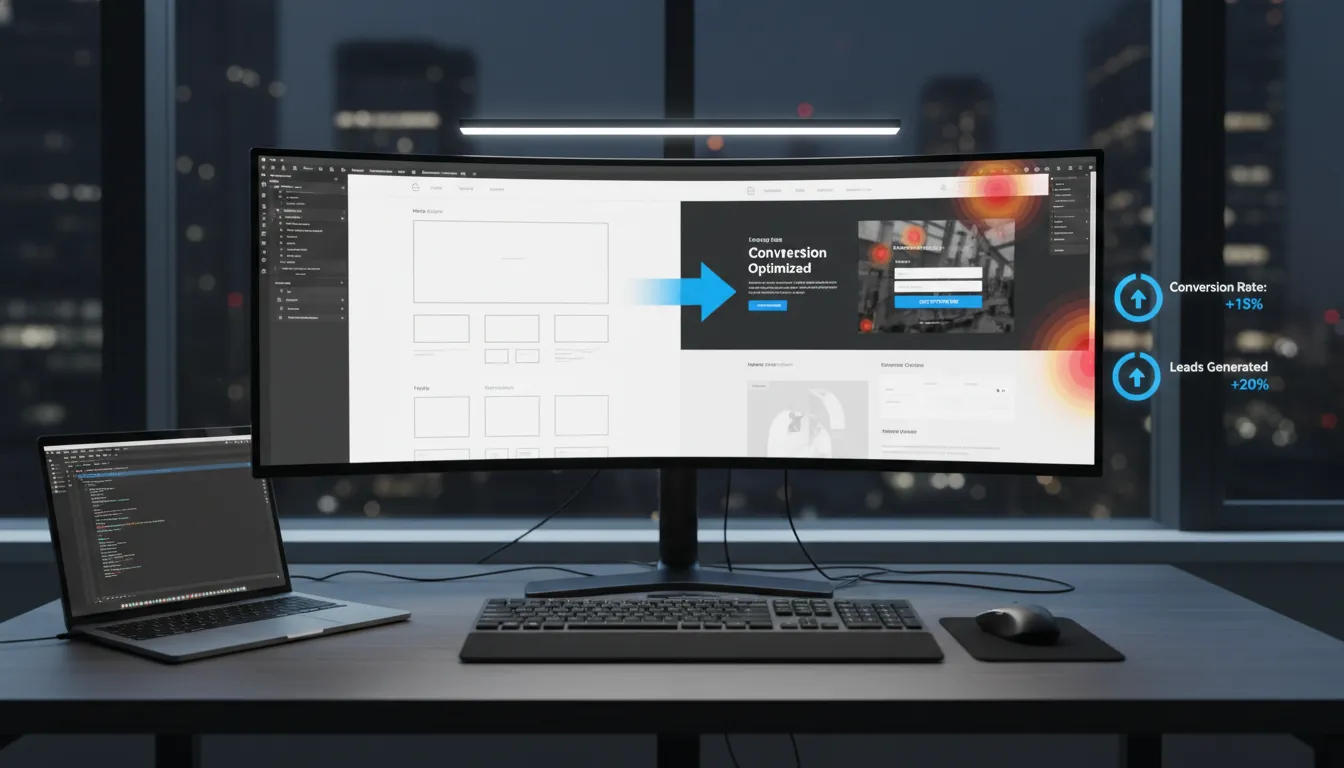
Every section of your website should have a purpose. Every element should push the user closer to action. From your headline to your CTA, everything should be aligned with one goal — conversion.
Here’s the bottom line.
Traffic without conversion is wasted money. A website should not be a digital brochure. It should be a growth engine.
And if your website isn’t generating leads consistently, it’s not doing its job.